
The Challenge: A fractional CFO practice had hit a growth ceiling. Their controller was spending 2-3 weeks every month manually categorizing 3,800 credit card transactions for a single client – leaving almost no capacity for additional work. The practice couldn’t grow without hiring, and hiring would erode the margins that made the fractional model work.
The Solution: FlowRunner automation that handles the mechanical categorization work (87-90% of transactions) and routes only the exceptions that require human judgment to the controller – reducing a 2-3 week process to under 2 days and freeing the controller to support additional clients.
Key Results:
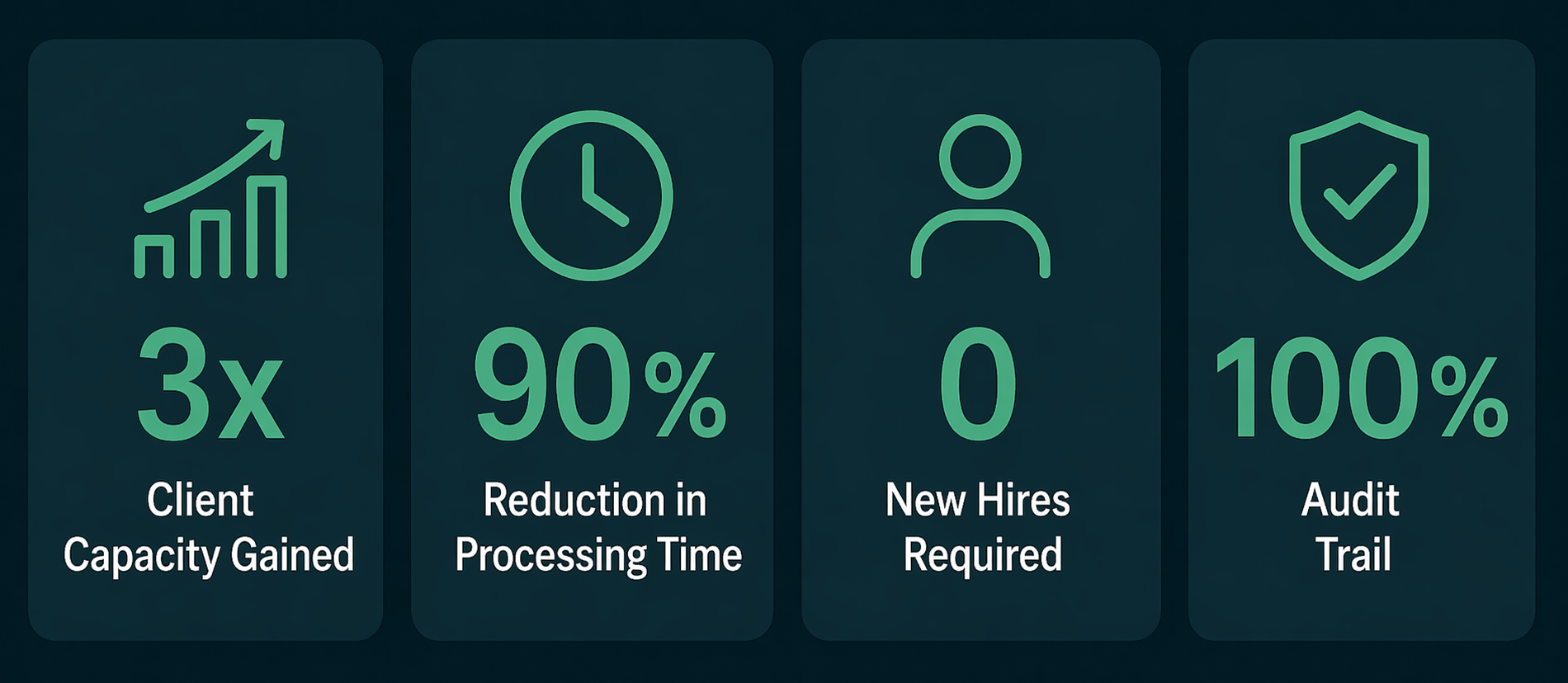
- Controller time on this client reduced from 2-3 weeks to under 2 days per month
- Fractional CFO expanded client base without adding headcount
- Same automation deployed across new clients, compounding the capacity gain
- Client-configurable rules: each client’s categorization logic is independent and adjustable without engineering changes
- Complete audit trail for every transaction, every exception, every decision – across all clients
- Human-in-loop workflow: FlowRunner handles pattern matching, pauses on exceptions, routes to controller with full context, escalates to CFO if unresolved
About the Client
A fractional CFO practice providing outsourced financial operations to multiple companies. The model works when each controller can serve several clients efficiently. When a single client consumes the majority of a controller’s month, the economics break. One of their clients runs all business expenses through corporate credit cards – 4 American Express accounts used by senior executives and 8 MasterCard accounts tied to sales operations. Combined monthly volume: approximately 3,800 transactions across 12 accounts.
The Challenge
One of their clients runs all business expenses through corporate credit cards – 4 American Express accounts used by senior executives and 8 MasterCard accounts tied to sales operations. In total, that’s roughly 3,800 transactions across 12 accounts every month.
Each month, the controller received statements from all 12 accounts and manually sorted every transaction: identifying the vendor, assigning a GL code, determining business purpose, and flagging anything that needed further review. At 3,800 transactions, this took 2-3 full weeks – leaving roughly one week per month for every other client and task.
Because of this, the CFO faced a choice most fractional CFO practice owners will recognize: hire another controller (adding fixed cost and shrinking margins), push back on the client (risking the relationship), or find a way to do the same work in less time without giving up accuracy.
The core insight was straightforward. Most of the controller’s time wasn’t spent on work that required her judgment. The bulk of transactions were simple – SaaS subscriptions, airline tickets, insurance premiums, known vendors with set GL mappings. This was pattern matching. Valuable only because someone had to do it, not because it required skill.
The 10-13% that truly required judgment – unknown vendors, unclear business purposes, possible personal charges on corporate cards – was where the controller’s expertise mattered. But she couldn’t get to those decisions without first working through the other 3,300+ transactions.
The Solution
FlowRunner automates the mechanical sorting work and puts only the exceptions – with full context – in front of the controller for decision. As a result, this is the pattern that allowed the practice to scale their fractional CFO practice from one capacity-trapped engagement to a repeatable, multi-client operation.
Statement Collection
First, FlowRunner sends the controller a scheduled reminder to pull statements from card provider portals. The controller then downloads statements and places them in a secure folder, and confirms via email. If no confirmation arrives, FlowRunner sends a follow-up. Once all 12 statements are received, processing begins right away.
This step matters for the fractional model because the controller doesn’t need to remember which clients need statements pulled when. Instead, FlowRunner tracks the schedule across all clients and prompts as needed.
Automated Categorization
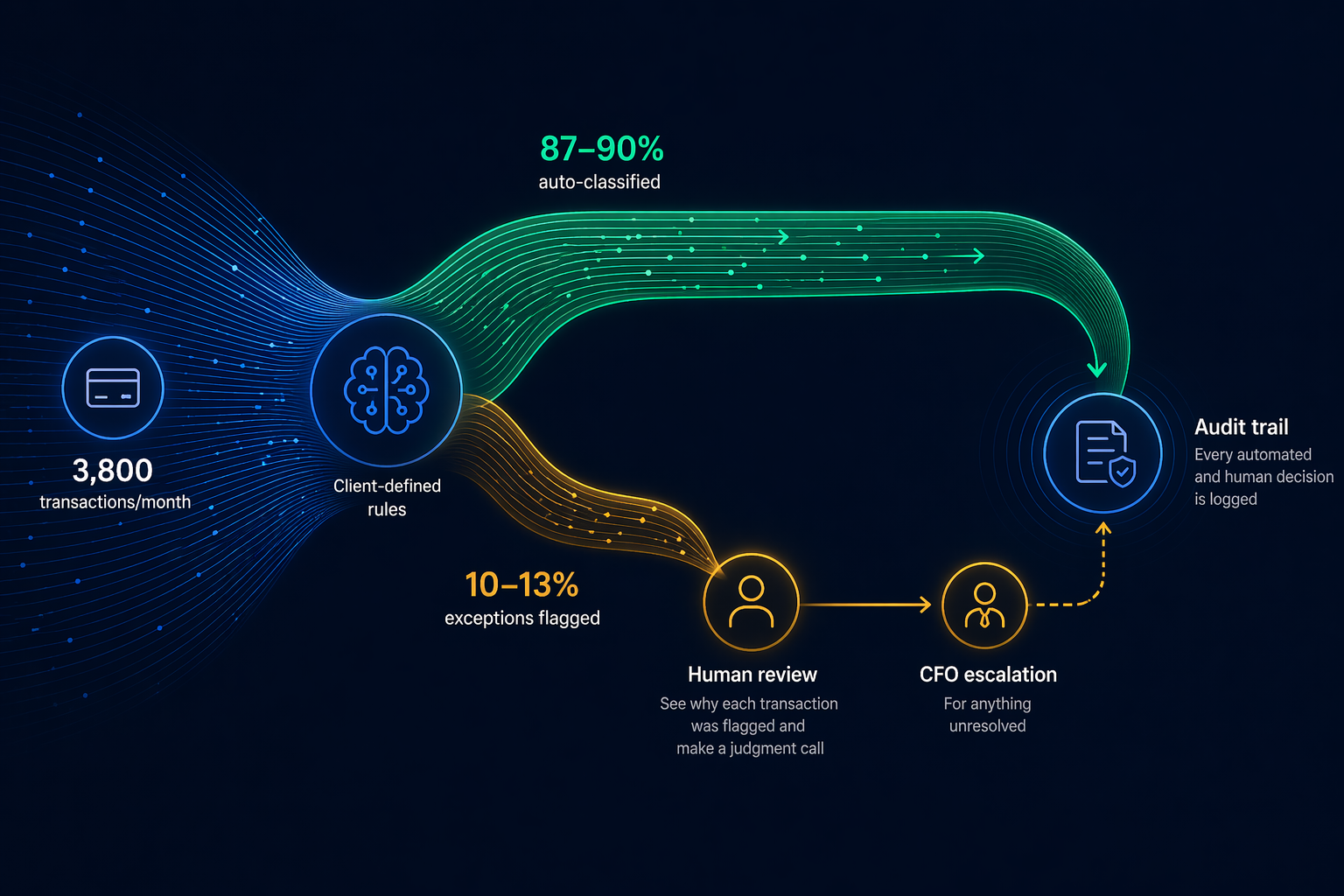
Next, FlowRunner processes each transaction against a set of client-defined rules covering vendor identification, GL code mapping, category assignment, and business purpose. Rules are specific to each client – for example, what counts as “Travel” for one company may map differently for another.
The client can update rules at any time. When spending patterns shift, new vendors appear, or chart of accounts structures change, the rules adapt without engineering work. This flexibility is key for fractional practices where every client has different preferences.
As a result, 87-90% of transactions that match known patterns are categorized on the spot. No manual review required.
Exception Handling
However, transactions that break a rule – unknown vendors, amounts outside expected ranges, unclear business purpose, or possible personal charges – are flagged as exceptions. Each exception includes the specific reason it was flagged along with the context the reviewer needs to make a decision.
From there, exceptions are routed to the controller via email. She reviews each one and makes the call. If an exception goes unresolved beyond a set time window, FlowRunner escalates to the CFO.
The same flow handles both the executive Amex accounts and the sales operations MasterCard accounts. Same rules engine, same exception logic, same escalation path.
Audit Trail
Finally, every step is logged: statement receipt, each sorting decision (automated or human), exception flags, resolution actions, escalation events, and final output. The audit trail is available for review at any time – by the controller, the CFO, or the client.
The Results
Controller capacity unlocked. The controller went from spending 2-3 weeks per month on one client’s credit card work to under 2 days. Now, her involvement is limited to resolving the 10-13% of transactions that truly require human judgment – with full context provided so each decision takes seconds, not minutes.
Practice growth without hiring. As a result, the freed capacity allowed the fractional CFO to bring on more clients. The same FlowRunner setup deploys for each new client with its own rule set and exception thresholds. In other words, each new client adds transaction volume but not matching controller time.
The compounding effect. Most importantly, the automation doesn’t just save time on one client — it creates a repeatable model. Client 2 gets the same setup. So does client 3. The controller’s workload grows with the number of exceptions, not the number of transactions. At a 10-13% exception rate, a controller who used to be consumed by one client’s 3,800 transactions can now handle exceptions from several clients totaling 10,000+ transactions – because she only touches the 1,000-1,300 that need her judgment.
Client gets a better service. Meanwhile, the client sees faster turnaround, fewer errors, steady sorting rules applied every month, and a complete audit trail. In short, the client experiences the automation as improved service quality, not reduced attention.
No margin erosion. Finally, the practice grew revenue without adding headcount. The cost of FlowRunner is a fraction of another controller’s salary. As a result, the fractional CFO model’s economics improved rather than shrank.
Looking Forward
The practice is now extending the same pattern to its growing client base, each with its own rule sets and exception thresholds. Because of this, the model scales naturally: each new client adds volume but not matching controller time, since FlowRunner handles the mechanical sorting regardless of how many accounts or transactions are involved.
In the next phase, the practice plans to add direct integration with accounting systems for automated posting of sorted transactions. They also plan to build expanded rule templates that speed up new client onboarding, along with additional automation of other recurring financial workflows that follow the same pattern — high-volume mechanical work with a small share requiring human judgment.
For any fractional CFO practice looking at how to scale without growing headcount, the underlying principle extends beyond credit card sorting: any process where skilled staff spend most of their time on pattern matching to reach the small share of decisions that require their expertise is a fit for the same approach.